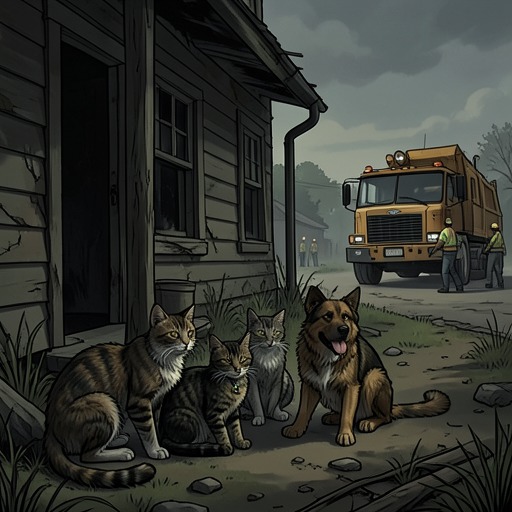
Rescuing and humanely handling the feral-cat colony
A Dog's Way HomeRescuing and humanely handling the feral-cat colony is the conflict that makes the cats beneath a condemned house visible before demolition can destroy their shelter. The effort pits a developer’s construction deadline against the time and care required to locate and protect animals living out of sight. Through Lucas’s feeding and intervention, and Audrey’s rescue organization’s work to halt the demolition, the colony becomes a test of whether humane treatment can be made part of decisions about property and development.
The colony and the threat of demolition
The cats live in the crawl space beneath a house in a row of buildings slated for demolition and replacement by an apartment complex. The developer wants the demolition completed by the end of June, leaving little time to remove the animals. A rescuer describes the danger in practical terms: simply removing cats without a workable plan could leave dead animals across the neighborhood. The urgency is not only that the house is about to come down, but that a whole colony is involved rather than one or two easily located cats.
The colony is difficult to count. During an initial visit, a rescuer explains that the female had recently been nursing, while any kittens remain hidden during the day; the sex of other cats is uncertain. The property had once held many more animals, and the developer says an outside company was brought in to trap them humanely. Yet the rescue community has heard of no corresponding influx of cats into shelters or other known parts of the system. Audrey points out that animal rescuers keep in close contact, and that a group of twenty cats would likely have become known. The discrepancy between the developer’s account and what the rescue network can verify leaves the fate and whereabouts of the missing cats unresolved.
Lucas’s intervention and rescue methods
Lucas’s connection to the cats begins with regular feeding. He crosses the street to reach a gap in the fence and leaves food near their den. Bella can smell three cats inside; Mother Cat stays out of view, while two others sometimes appear in the light. Lucas sometimes crawls into the den himself, and tells the cats that he will try to protect them but that they may have to flee if the machines arrive. His care is personal and repeated, but he understands that he cannot remain there all the time or control what happens to the house.
When Lucas sees a backhoe being unloaded, he acts immediately. He alerts his mother, gives her the rescue organization’s card, and sets out with Bella on a leash. At the house he tells the man in charge that cats are still living in the crawl space and that demolishing the building would kill them. Later, when the developer argues that the cats reproduce quickly and that many kittens die from hunger or disease unless they are caught and sterilized, Lucas does not deny the problem. Instead, he asks for time to let organizations dedicated to rescuing abandoned animals do their work humanely. The conflict is therefore not presented as a choice between construction and doing nothing: Lucas’s position is that the work can proceed after the cats have been given a chance to be found and handled responsibly.
The proposed intervention requires practical precautions. One rescue worker describes using large protective gloves while another person waits with a net to catch cats that get past the people searching the crawl space. The method reflects both the rescuers’ need to protect themselves and the difficulty of managing frightened animals in a confined space. It also shows why an announced removal is not equivalent to a completed rescue: hidden kittens may not emerge in daylight, and the people on site cannot initially say how many cats remain.
Permits, accountability, and outcome
The demolition threat becomes a public dispute when Audrey arrives with the rescue organization. She says the organization has contacted the building commission and that the demolition permit is being withdrawn because feral cats are present. The developer initially rejects this as impossible, but Audrey explains that a member of the organization’s board is a county commissioner. Her intervention turns the rescue effort into an immediate constraint on construction: if the house is demolished while the cats are there, she warns, the act would be illegal.
The developer claims that only a couple dozen cats were present and that an outside company trapped them humanely, while also saying he does not know where they went. Lucas’s account that he still sees cats, and his continued feeding, contradict the implication that the property is clear. Audrey’s pointed question about which shelter received the trapped cats makes the lack of a verifiable destination central to the dispute. The issue is not resolved by the word humane alone; the rescuers seek evidence that the animals have actually been accounted for and that those still in the crawl space can be reached before demolition resumes.
Later, Lucas’s mother reports that the cats will be all right. Audrey explains that the permits have been stalled until Gunter Beckenbauer allows the organization to enter and conduct a proper roundup of the remaining cats. The outcome is a delay and an opportunity for organized rescue, not a claim that the cats have already been removed or that every animal’s later fate is known. The distinction preserves the episode’s central concern: a humane intention must be joined to access, time, and an accountable plan.
A wider pattern of care
The colony episode belongs to a larger pattern in which care begins with noticing an animal or person in need and staying present rather than treating distress as someone else’s problem. In another setting, Ty takes Bella into rooms at a hospital where people welcome and pet her. Bella is then introduced to Mack, whom she recognizes as sad, and climbs onto his chair to comfort him. The scene is not part of the cat roundup, but it echoes the story’s insistence that care can be practical and relational: the cats need people to make room for a rescue, while Mack receives comfort through Bella’s presence.
Lucas later reads that fifteen percent of dogs can sense seizures, and his mother agrees that Bella seemed to recognize what was happening. The exchange further links animal care with attention to signs that a person or animal might otherwise overlook. At another point in Bella’s journey, she stays beside a distressed man and a dog as machines approach, believing that remaining there is her job, as it was when helping Ty and friends who needed a dog. These episodes broaden the meaning of rescue without equating different kinds of need. The colony’s protection depends on organized human action; Bella’s actions toward people and other animals show how the narrative also grants an animal her own persistent role in responding to vulnerability.
The colony’s hidden life beneath a house scheduled for demolition gives the conflict its moral and physical stakes. Lucas’s feeding makes the animals’ continued presence undeniable, while Audrey’s intervention makes the construction schedule answer to that presence. The eventual pause for a proper roundup offers a concrete, limited success: the cats are given a chance to be rescued before the house is destroyed, and humane handling is treated as a responsibility that requires time, coordination, and follow-through.